
EHRC Sexual Harassment Guidance 2026: What Employers Need to Review
On 30 October 2026, the Equality and Human Rights Commission (EHRC) updated its technical guidance on sexual harassment and harassment at work, alongside its Employer 8-Step Guide.
The update follows significant changes introduced by the Employment Rights Act 2025, strengthening employers' responsibilities to prevent workplace harassment.
Employers must now take all reasonable steps to prevent sexual harassment, and can be held liable for qualifying harassment by third parties where they have failed to take all reasonable steps to prevent it.
The guidance also addresses AI-generated sexual imagery, including deepfakes, and provides further direction on risk assessments, reporting, workplace culture and evaluating preventative measures.
For employers who reviewed their arrangements when the original preventative duty took effect in October 2024, this is an appropriate point to reassess whether those arrangements remain sufficient.
What changed in the EHRC's sexual harassment guidance on 30 October 2026?
The principal changes and developments are:
- A strengthened preventative duty. Employers must take all reasonable steps, rather than simply reasonable steps, to prevent sexual harassment.
- Third-party harassment liability. Employers can now be held liable for qualifying harassment by customers, clients, contractors and other third parties where all reasonable preventative steps haven't been taken. This extends beyond sexual harassment to harassment related to the protected characteristics covered by the legislation.
- Updated examples and practical guidance. The EHRC explicitly recognises AI-generated sexual imagery, including deepfakes, and provides updated direction on assessing risks, handling concerns and evaluating prevention.
The guidance doesn't replace the need for organisations to assess their own working environments. It establishes a framework for identifying risks and determining what prevention should look like in practice.
I've reviewed the updated guidance and identified the areas I would prioritise when evaluating an employer's existing sexual harassment prevention strategy.
1. What does 'all reasonable steps' mean for employers?
The strengthened preventative duty requires employers to identify and implement all measures that are reasonable in their circumstances.
Reasonableness remains an objective assessment. Factors include the organisation's size and resources, working arrangements, sector, identified risks and the likely effectiveness of potential measures.
The important distinction is that implementing several reasonable controls may be insufficient where other reasonable measures remain outstanding.
An organisation may have a comprehensive sexual harassment policy and an established training programme, but these measures won't necessarily address risks arising from lone working, particular customers, digital communications or workplace power dynamics.
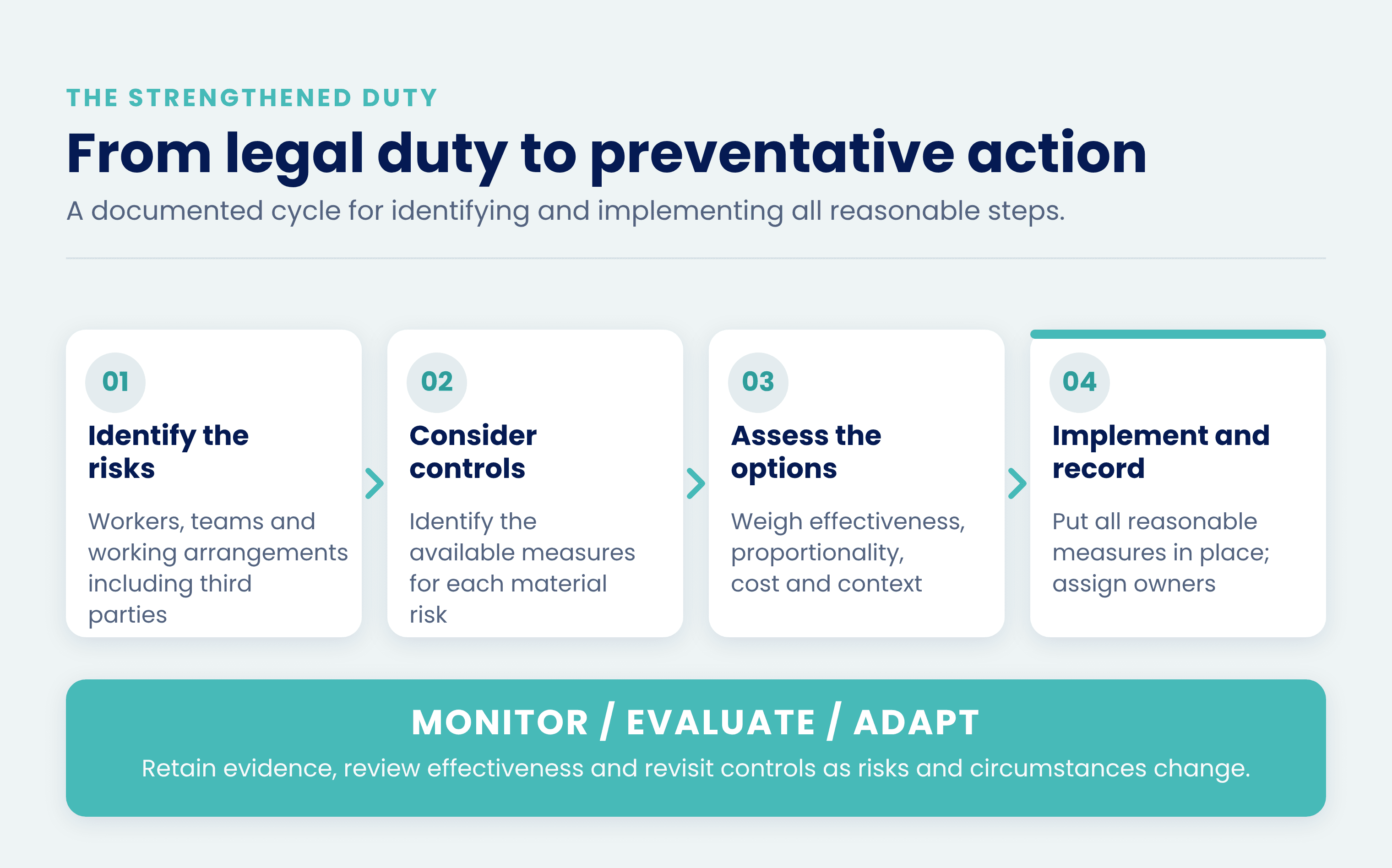
Employers need a systematic approach to identifying risks, selecting controls and recording the decisions made.
Practical recommendations
Employers should maintain a documented prevention action plan that identifies:
- The risks identified through consultation and assessment.
- The potential preventative measures considered.
- Which measures are reasonable and why.
- Responsibility and timescales for implementation.
- Evidence of effectiveness and outstanding actions.
The obligation is continuous. Employers should revisit their decisions as risks, working arrangements and organisational circumstances change.
2. Is a sexual harassment risk assessment necessary?
The EHRC states that employers are unlikely to comply with the preventative duty without conducting a sexual harassment risk assessment.
Although a risk assessment isn't expressly prescribed as a standalone statutory requirement, it is a central part of demonstrating that an organisation has identified and addressed its particular risks.
The assessment should consider more than obvious incidents or physical working conditions.
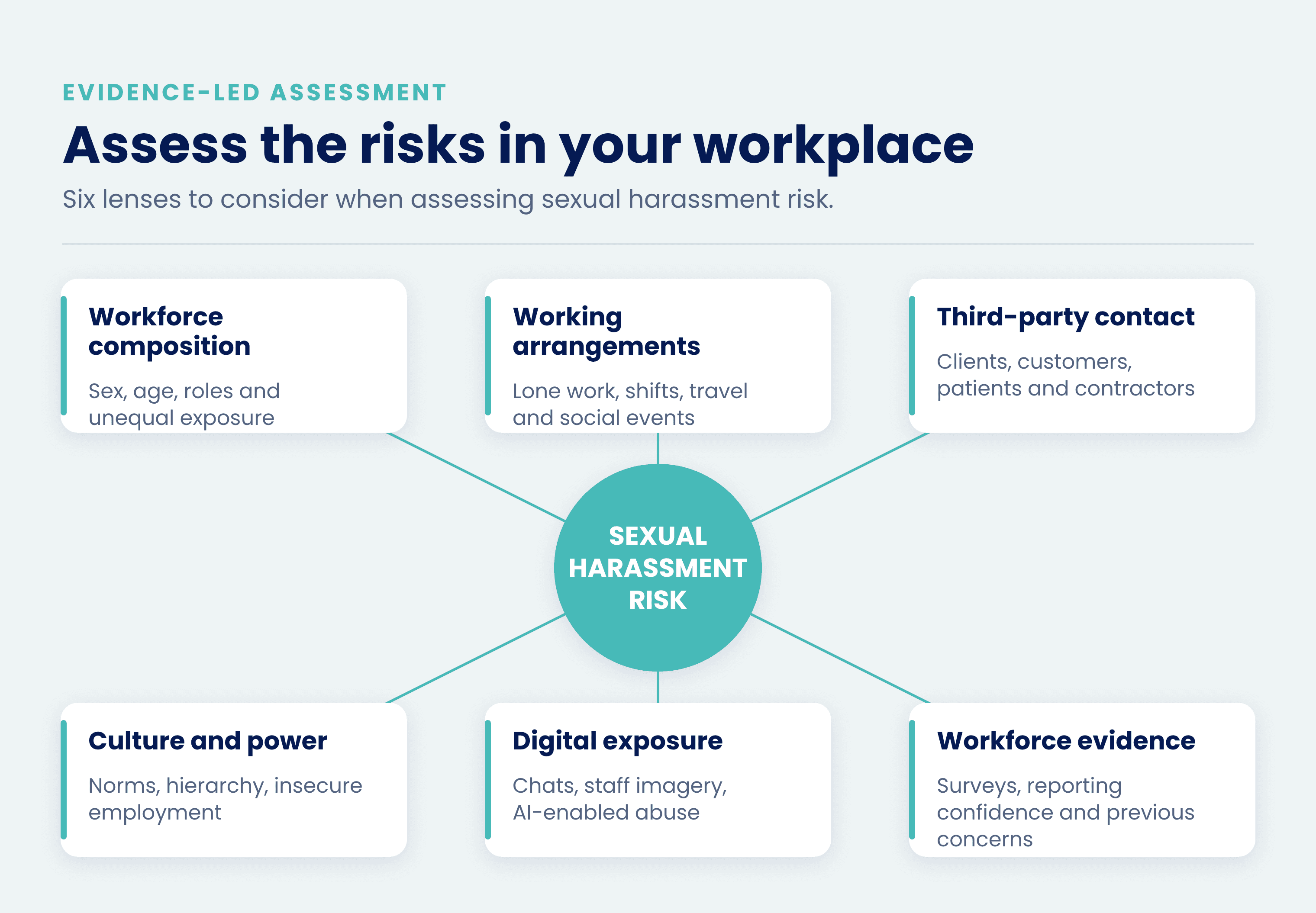
It needs to examine the workforce, organisational culture, working arrangements, exposure to third parties and circumstances in which inappropriate behaviour may occur.
What should a sexual harassment risk assessment include?
I would recommend examining six areas:
- Workforce composition: Demographics, role distribution, seniority, employment insecurity and potentially disproportionate exposure.
- Working arrangements: Lone working, night shifts, travel, social events and isolated environments.
- Third-party contact: Customers, clients, contractors, patients, service users and other external parties.
- Culture and power: Gender stereotypes, workplace norms, power imbalances and the behaviours that are challenged or tolerated.
- Digital exposure: Workplace messaging, social media, employee imagery and technology-facilitated harassment.
- Workforce evidence: Complaints, informal concerns, employee surveys, reporting confidence and previous incidents.
A particular consideration is the difference between demographic risk factors and evidence of workplace culture.
For example, a predominantly male workforce may warrant assessment of masculinity norms and attitudes towards women, but demographic composition alone doesn't establish whether harmful attitudes are present.
These risks require investigation through appropriate workforce evidence.
The findings should inform a prioritised action plan. Completing a risk assessment without implementing its recommendations will do little to demonstrate effective prevention.
For organisations requiring independent assessment, our sexual harassment consultancy services include workplace-specific risk assessments and prevention strategy development.
3. What are employers' responsibilities for third-party harassment?
From 30 October 2026, employers can be held liable for qualifying harassment committed by third parties in the course of employment where they haven't taken all reasonable steps to prevent it.
Third parties may include customers, clients, suppliers, contractors, patients, service users and members of the public.
Importantly, this liability isn't restricted to sexual harassment. It also covers harassment related to the protected characteristics within the relevant provisions of the Equality Act 2010.
The practical implications will differ considerably between sectors and roles.
A hospitality worker dealing with intoxicated customers, a healthcare professional working with patients and a consultant working with an influential client may all experience different risks and barriers to reporting.
Practical measures employers should consider
- Communicating standards of behaviour to clients, customers and contractors.
- Including relevant behavioural expectations within commercial agreements and site procedures.
- Establishing safe escalation and intervention arrangements.
- Enabling employees to seek assistance or disengage from inappropriate interactions.
- Recording and monitoring third-party incidents.
- Training managers to intervene, including where commercial relationships may be affected.
Third-party harassment prevention must be operationally realistic.
A policy that instructs employees to report inappropriate behaviour is insufficient if managers lack the authority, confidence or willingness to address the people responsible.
Employers should also consider whether commercial pressures or workplace power dynamics make some employees particularly reluctant to raise concerns.
4. AI-generated sexual imagery and deepfakes are now explicitly recognised
The EHRC's updated technical guidance explicitly includes AI-generated sexual imagery, including deepfakes, within its examples of conduct of a sexual nature.
This is an important development and one I've advocated for publicly.
In January 2026, I wrote for People Management about the absence of deepfakes and AI-generated sexual imagery from the EHRC's guidance. I've also incorporated technology-facilitated sexual harassment into every sexual harassment prevention training session I've delivered for well over a year.
The update is welcome, but it exposes a broader challenge.
Technology is developing faster than many organisations are reviewing their prevention arrangements. Employers who rely exclusively on behaviours expressly identified in legislation or regulatory guidance risk overlooking emerging forms of abuse.
What should employers review?
Sexual harassment policies, training and risk assessments should address the potential misuse of technology, including:
- Creating or manipulating sexualised images of colleagues without consent.
- Displaying or distributing sexualised AI-generated material.
- Threatening to create or share sexual imagery.
- Using work-related messaging platforms or social media to facilitate harassment.
- Handling reports involving digital sexual imagery and preserving relevant evidence appropriately.
Managers also need to understand the potential psychological impact of this abuse.
The fact that an image is synthetic doesn't diminish the distress, humiliation or reputational harm that may follow its creation or circulation.
Technology hasn't created the underlying attitudes associated with sexual harassment and gender-based violence. It has provided additional means through which those behaviours can be perpetrated.
Prevention strategies need to anticipate emerging risks, not simply respond when guidance catches up.
5. Workplace culture and power dynamics influence harassment risk
Power dynamics can influence both the likelihood of harassment and whether employees feel able to challenge or report it.
These dynamics aren't limited to formal management hierarchy. They may arise through employment insecurity, access to opportunities, financial dependence, informal influence or established relationships within a team.
They also affect active bystander intervention.
An employee may recognise inappropriate behaviour but remain reluctant to challenge a senior colleague, influential customer or person who controls their opportunities.
For this reason, workplace sexual harassment training should address more than definitions and reporting procedures.
It should examine the psychological and social barriers to intervention, alongside practical techniques employees can use safely.
The four Ds of bystander intervention, Direct, Distract, Delegate and Delay, can provide a useful framework, but employees need to understand when different approaches are appropriate.
Managers must also recognise how their responses establish behavioural expectations.
Where influential individuals are repeatedly excused from accountability, formal policies and organisational statements lose credibility.
6. Reporting procedures must reflect the realities of disclosure
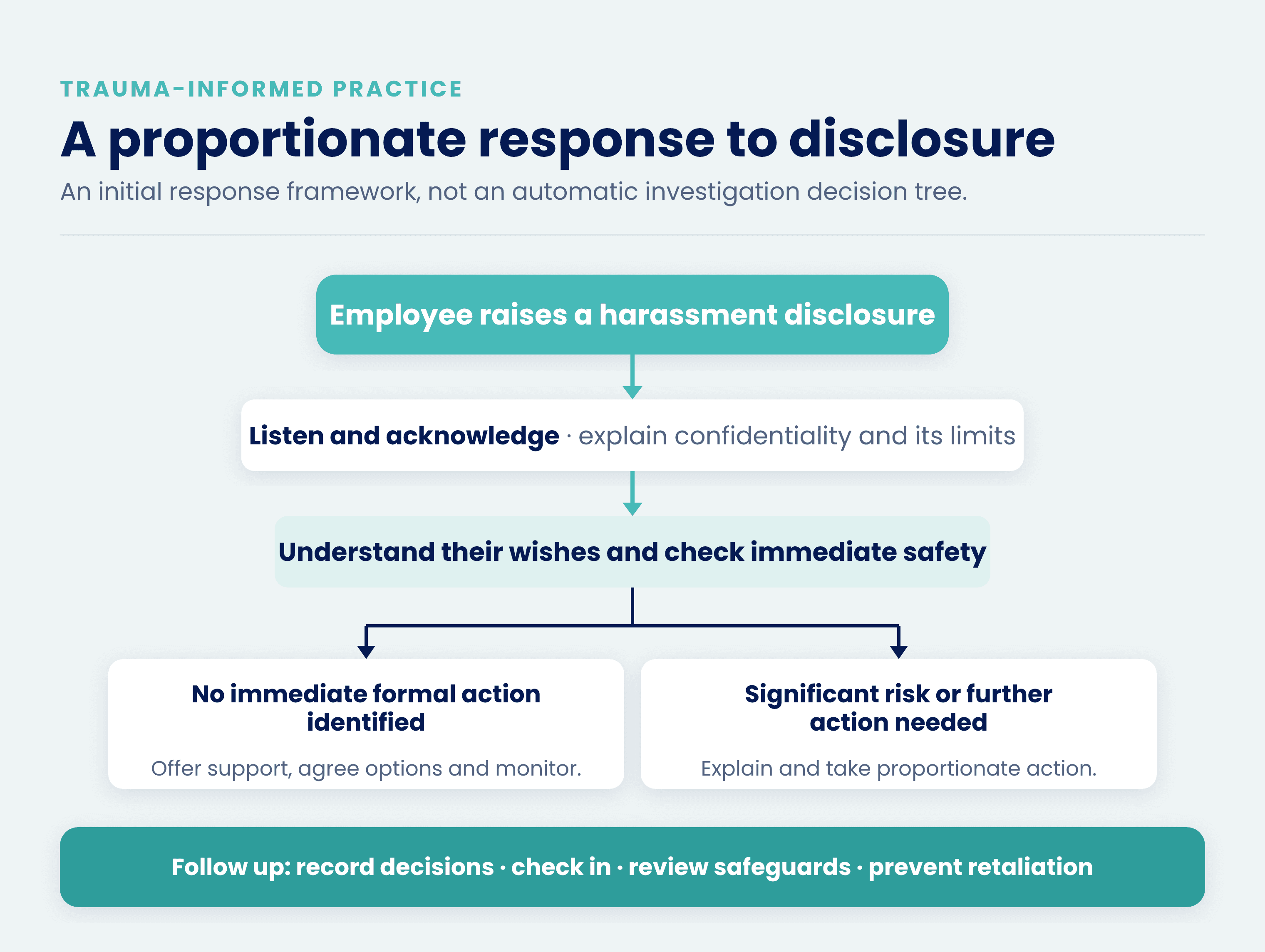
The EHRC's updated guidance addresses circumstances where an employee discloses harassment but asks their employer not to take further action.
Employers should respect those wishes wherever possible, while recognising that further intervention may be necessary where continuing risks, serious concerns or wider responsibilities justify it.
This is an area where trauma-informed practice can strengthen organisational responses.
An employee who has experienced harassment may already feel that their autonomy has been compromised. Unnecessarily removing their involvement in subsequent decisions can compound that harm.
Practical recommendations
Review whether reporting and investigation procedures address:
- Confidentiality and its limitations.
- Employee autonomy and involvement in decisions.
- Minimising unnecessary repeated disclosures.
- Appropriate support and safeguards.
- Proportionate escalation and informal resolution.
- Protection against victimisation and retaliation.
A trauma-informed response doesn't mean avoiding formal action. It means taking appropriate decisions while recognising the potential impact on the people involved.
Employers should also consider the interaction between harassment and whistleblowing arrangements.
Since 6 April 2026, sexual harassment has been expressly recognised as a category of wrongdoing that may form the basis of a protected whistleblowing disclosure, provided the statutory conditions are met.
Sexual harassment, grievance and whistleblowing policies should therefore be reviewed together.
The updated guidance also addresses the interaction between harassment protections and expressions of religious or philosophical belief. Employers should assess conduct, context and proportionality rather than adopting blanket prohibitions on controversial opinions.
7. How should employers measure whether prevention is effective?
The EHRC emphasises the importance of monitoring and evaluating preventative measures.
A frequent weakness in organisational prevention strategies is the reliance on evidence of activity rather than evidence of effectiveness.
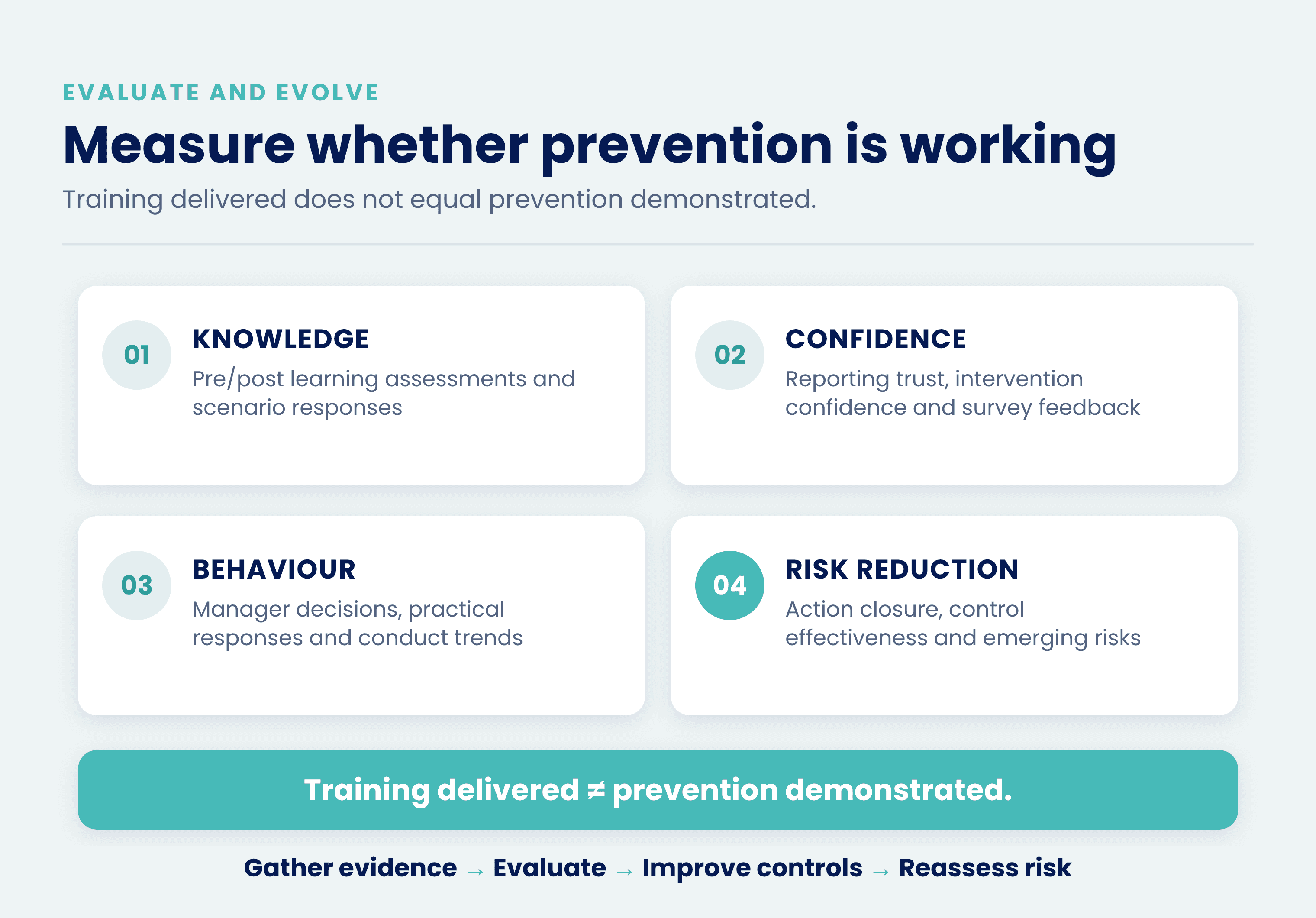
Training completion records, policy acknowledgements and annual reviews demonstrate that activities have taken place. They don't necessarily establish whether employees have understood the learning, managers can apply it or workplace risks have reduced.
The case of Allay (UK) Ltd v Gehlen remains relevant when considering the effectiveness of anti-harassment training.
What evidence should employers collect?
I recommend evaluating four areas.
Knowledge: Pre- and post-training assessments, practical scenarios and employee understanding of inappropriate behaviours.
Confidence: Whether employees understand reporting routes, trust management responses and feel able to intervene.
Behaviour: How managers respond to concerns, whether inappropriate behaviour is challenged and how procedures are applied.
Risk reduction: Implementation of preventative controls, workforce feedback, incident trends and changes in identified risks.
These measures should be considered together.
For example, an increase in formal reporting may reflect improving employee confidence rather than an increase in harassment. Conversely, low complaint numbers may indicate significant barriers to reporting.
Behaviour-based workforce surveys can be particularly valuable.
Asking employees whether they've experienced specific behaviours, such as unwanted sexual comments or inappropriate sexual messages, may provide more meaningful evidence than asking only whether they have experienced sexual harassment.
Evaluation should inform further action, not simply demonstrate that activities have been completed.
What should employers do following the October 2026 EHRC update?
For employers who last reviewed their arrangements when the original preventative duty took effect in October 2024, I recommend five immediate priorities.
- Review policies and procedures. Ensure they reflect the strengthened preventative duty, third-party harassment, technology-facilitated abuse and relevant whistleblowing protections.
- Update the sexual harassment risk assessment. Use current workforce information, consultation and evidence of cultural, operational and digital risks.
- Review existing preventative controls. Identify additional measures, assess their reasonableness and document implementation decisions.
- Evaluate reporting arrangements and management capability. Consider confidentiality, trauma-informed responses, escalation and protection against retaliation.
- Establish ongoing evaluation. Measure training effectiveness, reporting confidence, management practice and changes in workplace risk.
These actions provide a starting point, not an exhaustive compliance checklist.
The measures required will depend on each employer's circumstances, and the assessment should be revisited as new risks and information emerge.
Specialist support for Worker Protection Act compliance
The updated EHRC guidance reinforces the need for employers to approach sexual harassment prevention as an ongoing organisational responsibility.
Legally accurate policies are necessary, but their effectiveness depends on how well they reflect the workplace, the risks employees face and the organisation's ability to respond appropriately.
At OneSource HR, our sexual harassment prevention work draws on specialist knowledge of employment law, gender-based violence, trauma-informed practice and workplace behaviour.
We support employers with policy development, independent risk assessments, training, reporting arrangements and evaluating the effectiveness of preventative measures.
Our three-tier Worker Protection Act readiness and compliance offering provides options for organisations requiring specialist policies and an action plan, an independent risk assessment, or a more comprehensive approach incorporating training and learning impact measurement.
Explore your options:
-
Worker Protection Act readiness and compliance packages
Explore our three levels of support, from specialist policies and action planning through to independent risk assessment and training. -
Specialist sexual harassment consultancy
Find out more about bespoke sexual harassment prevention strategies, risk assessments, policy reviews and organisational support.
If your organisation hasn't reviewed its sexual harassment prevention arrangements since the original duty came into force, contact OneSource HR to discuss a specialist review.
The legislation has strengthened, and the risks employers need to manage continue to evolve. Prevention arrangements should reflect both.
Frequently asked questions about the EHRC's 2026 sexual harassment guidance
What changed in the EHRC sexual harassment guidance on 30 October 2026?
The EHRC updated its technical guidance and Employer 8-Step Guide to reflect strengthened workplace harassment protections. Employers must now take all reasonable steps to prevent sexual harassment, and can be held liable for qualifying third-party harassment where they haven't taken all reasonable preventative steps. The guidance also explicitly addresses AI-generated sexual imagery, including deepfakes.
What does 'all reasonable steps' mean under the Worker Protection Act?
Employers must identify and implement all preventative measures that are reasonable in their circumstances. The assessment considers factors including organisational size, resources, working environment, sector and identified risks. Introducing some reasonable measures may be insufficient if other reasonable steps remain outstanding.
Is a sexual harassment risk assessment a legal requirement?
A sexual harassment risk assessment isn't expressly prescribed as a standalone statutory requirement. However, the EHRC states that employers are unlikely to comply with the preventative duty without conducting one. The assessment should identify workplace-specific risks, inform preventative measures and be regularly reviewed.
Can employers be liable for harassment by customers or clients?
Yes. From 30 October 2026, employers can be held liable for qualifying harassment by third parties, including customers, clients and contractors, where they have failed to take all reasonable steps to prevent it. The provisions extend beyond sexual harassment to harassment related to the protected characteristics covered by the legislation.
Does workplace sexual harassment include AI-generated images and deepfakes?
Yes. AI-generated sexual imagery, including deepfakes, can constitute sexual harassment where the relevant legal definition is satisfied. The EHRC's updated guidance explicitly includes this behaviour among its examples of unwanted conduct of a sexual nature. Employers should consider these risks within relevant policies, training and risk assessments.
What should an employer do if an employee reports sexual harassment but doesn't want an investigation?
Employers should consider the employee's wishes and respect them wherever possible, while assessing the seriousness of the concern and any continuing risks. Appropriate action may include support, informal options, monitoring and proportionate preventative measures. Where further intervention is necessary, the employer should explain its decision and provide appropriate safeguards.
How often should employers review their sexual harassment prevention arrangements?
Prevention arrangements should be reviewed regularly and whenever relevant circumstances change. The EHRC recommends monitoring and evaluating policies and preventative measures to establish whether they remain effective. Changes in workforce composition, working arrangements, emerging technology or reported concerns may all require an earlier review.
Does sexual harassment qualify for whistleblowing protection?
Since 6 April 2026, sexual harassment has been expressly included among the categories of wrongdoing that can form the basis of a protected whistleblowing disclosure. The relevant statutory conditions must still be met, including the public-interest requirement. Not every personal complaint automatically qualifies as a protected disclosure.
This article reflects the legal framework and EHRC guidance applicable in England, Scotland and Wales as at 3 November 2026. The practical recommendations also reflect specialist professional experience in sexual harassment prevention and trauma-informed HR practice.