
Case study
When "banter" becomes harassment: investigating male-to-male sexual harassment
How a trauma-informed approach cut through bias in a sales-driven culture where "boys will be boys" had become the default explanation.
The situation
We were instructed by a financial services business with a high-volume, heavily sales-driven culture. The environment had, over time, developed the characteristics of a "boys' club", and "boys will be boys" had quietly become an explanation for a great deal.
A male employee had made persistent jokes about a male colleague's relationships, and repeatedly speculated about his sexual activity. The conduct was sustained. Its effect was to create an environment that was degrading, offensive and humiliating for the person on the receiving end of it.
That is the legal test for harassment. It does not require malice. It does not require the conduct to be aimed at a woman. And it is not disapplied because everybody was laughing.
The complexity
Male-to-male sexual harassment is among the most poorly handled casework in UK organisations. Not because investigators are careless, but because the biases at play are so deeply absorbed that they operate invisibly.
In a case like this one, an investigator or hearing manager can easily let the following distort their judgement.
Male stereotyping
An assumption that men do not find this kind of conduct distressing, or that a man who complains must be unusually sensitive, humourless, or unable to cope in a robust environment.
The defensive attribution hypothesis
The unconscious instinct to attribute some responsibility to the person harmed, because doing so preserves a comforting belief that this could not happen to us. The more we identify with the complainant, the more we look for what they did to invite it.
Absorbed toxic masculinity and patriarchal norms
The unexamined idea that sexualised talk between men is fundamentally harmless, that objecting is a failure of masculinity, and that "banter" is culturally protected territory.
Societal myths about sexual misconduct
That harassment must involve a woman. That it must involve physical contact. That it must be intended.
Each of these biases pushes in the same direction, towards minimising the conduct, doubting the complainant, and finding that nothing much happened. In a culture already primed to say "boys will be boys", the outcome writes itself before the evidence is examined.
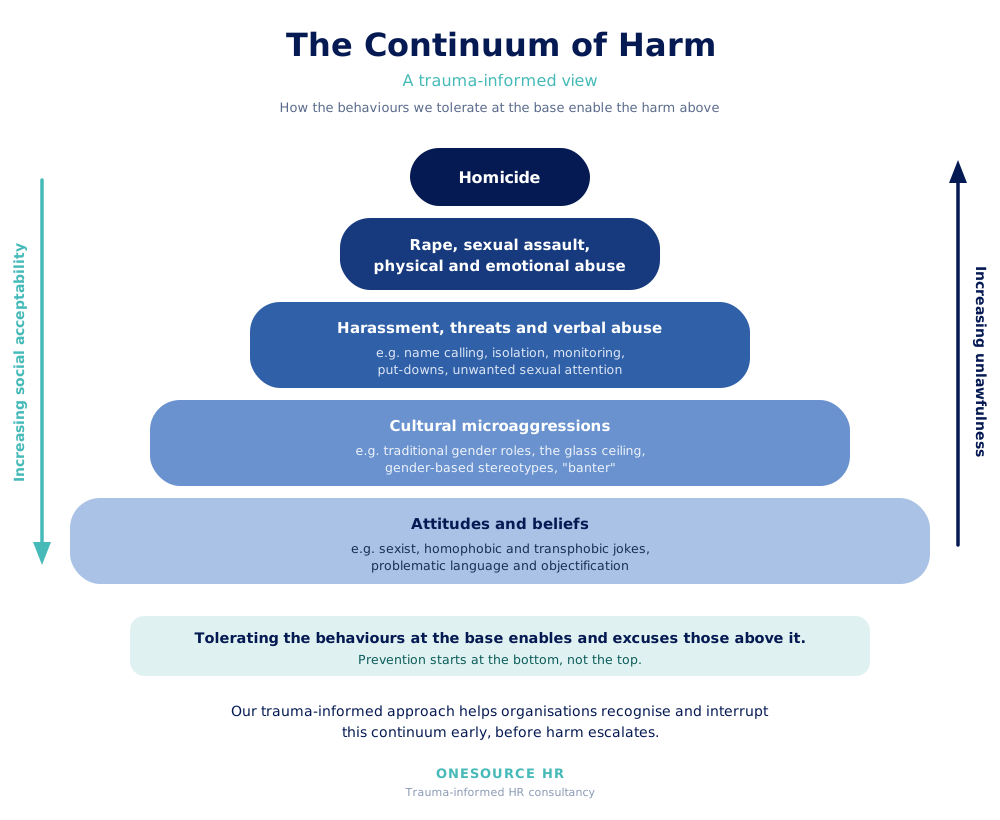
Tap the diagram to view it full size.
The trauma-informed approach
Trauma-informed practice is what interrupts that.
It means understanding that a man disclosing this kind of conduct is doing so in an environment that has already told him, repeatedly, that his complaint is a joke. It means recognising that his hesitation, his minimising language, his apparent tolerance of it at the time, are not evidence that it did not harm him. They are evidence of the culture he was in.
It means examining our own inferences before we examine his account. It means asking why we are inclined to believe one man over another, and what that inclination is really made of.
We investigated the conduct on its merits, against the legal test, without allowing the culture of the organisation, or our own absorbed assumptions, to determine the answer in advance. We treated the complainant's experience as evidence rather than as sensitivity. We treated the respondent fairly, and we did not confuse the absence of malice with the absence of harm.
The outcome
The case was resolved fairly and swiftly.
The organisation received an outcome it could stand behind, reached through a process that could withstand scrutiny, and a clear-eyed view of a culture that had allowed the conduct to continue unchallenged for too long.
The greatest risk is not that an investigator will be biased. It is that they will not know they are.
What this case shows
Harassment does not require a female complainant, a physical act, or an intention to harm. It requires conduct of a sexual nature that violates dignity, or creates an intimidating, hostile, degrading, humiliating or offensive environment. That is all.
"Banter" is not a defence. It is frequently the mechanism.
And the greatest risk in cases like this is not that an investigator will be biased. It is that they will not know they are.
If you are handling a harassment case in a culture that has normalised the conduct, or one where you suspect your own assumptions may be doing more work than the evidence, involve an independent specialist.
Facing a complex or sensitive disciplinary, grievance or investigation?
Talk to our team. There is no obligation, and no sales script.