
Case study
Disability discrimination before the first day: investigating a complaint from a new starter who never started
How a trauma-informed investigation resolved an emotionally charged complaint, uncovered assumption rather than malice, and protected a household-name brand.
The misconception that puts employers at risk
Many organisations assume the risk of discrimination begins on an employee's first day. It does not.
Protection under the Equality Act 2010 applies to job applicants and to those holding an offer of employment. Section 60 generally prohibits questions about health or disability before a job offer is made, though a conditional offer followed by a health questionnaire is permitted. Where an offer is then altered or withdrawn because of a disability, or a perceived one, a disability discrimination claim can follow. If a prohibited question was asked, the burden of proof shifts to the employer to demonstrate that discrimination did not occur.
A person who never works a single day for you can still bring a claim. And compensation for discrimination is uncapped.
A person who never works a single day for you can still bring a claim.
The situation
We were instructed by a household-name brand with eleven UK sites.
A new starter had disclosed a chronic illness during their pre-employment health questionnaire. They alleged that a very senior leader had subsequently changed the terms of the role, rendering it untenable, and they never commenced employment.
The complaint was serious, and the circumstances were difficult. The internal HR team were implicated throughout, meaning no one inside the organisation could credibly investigate it. The atmosphere was emotionally charged. A senior leader's conduct was in question, and the complainant was a person outside the organisation entirely, with no employment relationship and none of the usual protections of an internal process.
The process
Because the complainant was not an employee, a standard grievance procedure did not apply. We designed and ran an amended, shortened grievance process, appropriate to their status while preserving fairness, rigour, and defensibility. Independence was essential. So was speed, and so was care.
The trauma-informed approach
Understanding the complainant’s circumstances was central to reaching a sound outcome. The 5 R’s of trauma-informed practice shaped how we did that.
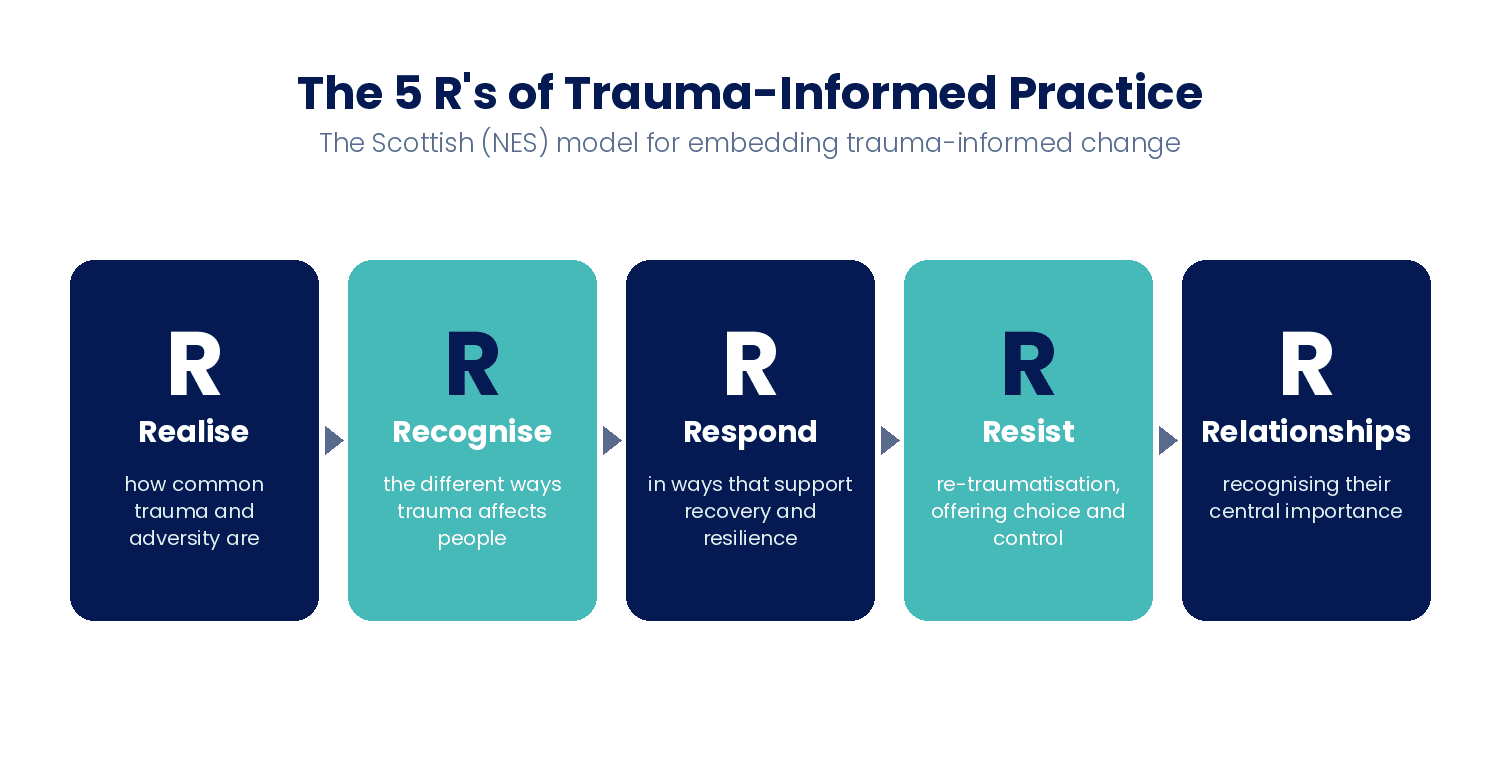
Realise
We realised that this person was not arriving at the situation as a blank slate. Their recent employment history had been difficult, and they were carrying vicarious trauma forward into this new experience. That context was not incidental. It was central.
Recognise
We recognised how that history was shaping their interpretation of events. A change to role terms, ambiguous in itself, was being read through the lens of what had happened to them before. This did not make their complaint invalid. It made understanding it essential.
Respond
We responded by investigating thoroughly and independently, testing every assumption on every side. We examined what was said, what was meant, what was heard, and the gap between them.
Resist re-traumatisation
We ran a process that did not require the complainant to relive their history, or defend their own credibility, in order to be taken seriously. Their disclosure of a chronic illness was treated as information, never as a liability.
Relationships
We understood that how every party experienced this process would determine whether the outcome could be accepted. Including the senior leader, whose conduct was under scrutiny.
The finding
The situation had arisen from a genuine misunderstanding, compounded by assumptions made on multiple sides. There was no malicious wrongdoing.
That finding was only reachable because we understood the complainant's circumstances properly. Without that understanding, an investigator would have faced two equally poor options: dismiss the complaint as an overreaction, or find discrimination where none existed. Both would have been wrong. Both would have been costly.
What this case shows
Discrimination protection does not begin on day one. It begins at application.
Emotionally charged cases are not resolved by choosing a side quickly. They are resolved by understanding what each person brought into the room, including the history they carried with them, and by running a process robust enough to hold whatever the truth turns out to be.
Sometimes the finding is that nobody set out to cause harm. Reaching that conclusion credibly, in a way both parties can accept, takes more skill than finding fault.
If your HR team is implicated, if a senior leader’s conduct is in question, or if a complaint arrives before employment has even begun, involve an independent specialist early.
Facing a complex or sensitive disciplinary, grievance or investigation?
Talk to our team. There is no obligation, and no sales script.